Introduction
When buying a new smartphone, people often compare the camera, battery, processor, and RAM.
however, the display is equally important. We use our phone screens to watch videos, play games, view photos, and browse social media—consequently, the quality of the display significantly influences our overall user experience.
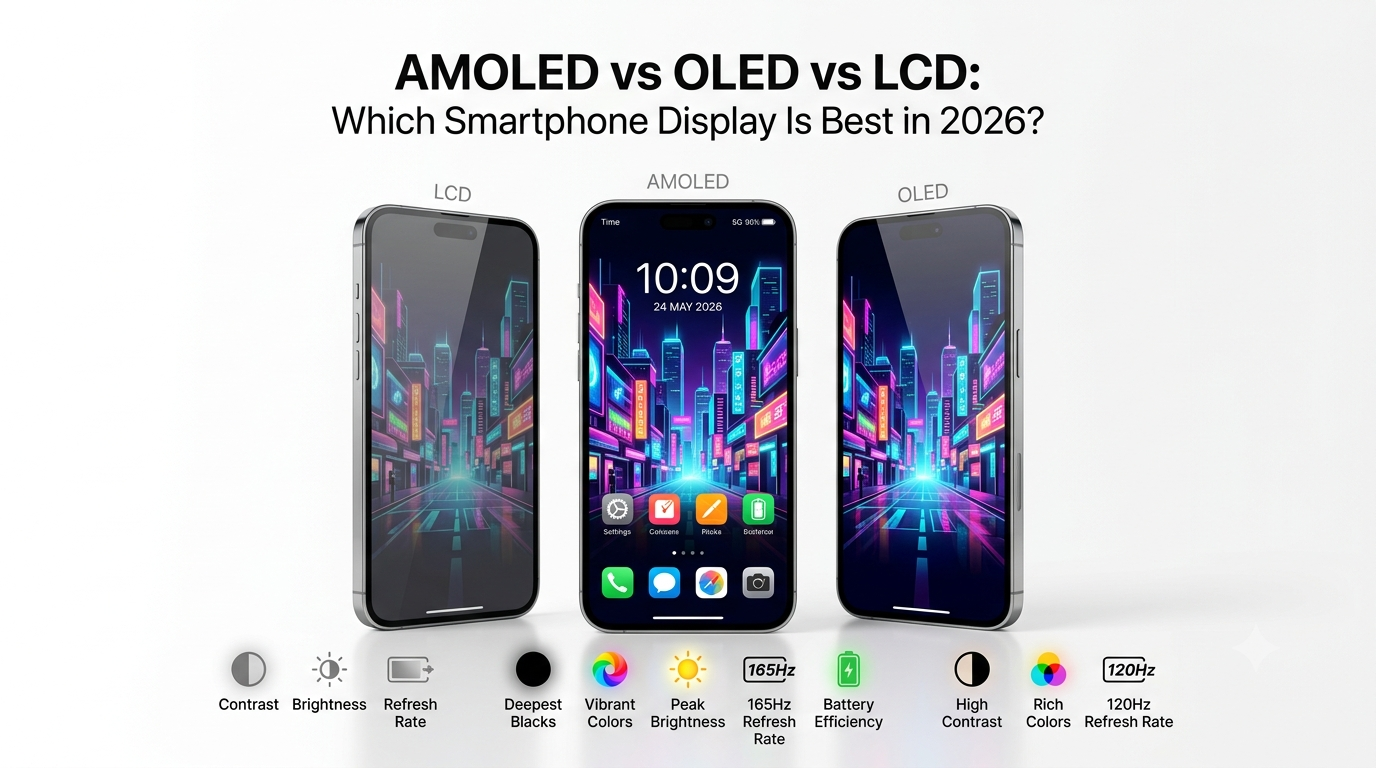
Nowadays, smartphones primarily feature LCD, OLED, or AMOLED displays.
Each of these technologies has its own set of strengths and limitations.
Some screens offer superior color reproduction, others are known for their deep, true blacks, while some serve as excellent, cost-effective options for more affordable phones.
If you are planning to purchase a new smartphone but are unsure whether an AMOLED, OLED, or LCD display is the better choice, this article is for you.
Here, we will break down these technologies in simple terms to help you determine which option is the best fit for your needs.
What is an lCD display
The full form of LCD is 'Liquid Crystal Display'.
This technology has long been used in smartphones, TVs, laptops, and monitors.
In an LCD screen, the pixels do not produce light themselves.
they require a backlight from behind to display an image.
When you view a photo or video on the screen, the LCD panel controls the light to produce various colors.
The quality of the display depends on the type of backlight panel used and other technical specifications.
Advantages of LCD displays
The biggest advantage of an LCD is its cost-effectiveness, which is why this technology is commonly found in budget smartphones.
A good LCD screen is more than sufficient for everyday tasks like browsing, using social media, online learning, and watching videos.
Some LCD panels offer good visibility even in bright light, though the actual brightness depends on the specific phone model.
In an LCD screen, a single backlight illuminates the entire display area.
consequently, it is difficult to render black colors with the same depth as seen on OLED displays.
Drawbacks of LCD displays
In an LCD, the backlight is constantly active, which means some light may be visible even in areas that are supposed to be black.
consequently, when watching videos in a dark room, black tones might appear somewhat greyish.
Furthermore, the contrast and depth of blacks in some LCD panels are not as good as those found in more expensive OLED panels.
However, not all LCD screens are the same; a high-quality LCD panel can offer an excellent viewing experience for the average user.
What is an oLED display
The full form of OLED is 'Organic Light-Emitting Diode'.
In this technology, each pixel can generate its own light.
therefore, unlike traditional LCDs, OLED displays do not require a separate backlight.
The most significant feature of OLED is its ability to produce deep black tones.
When a black color needs to be displayed on any part of the screen, the corresponding pixels can simply turn off.
This results in better contrast and more vivid, realistic visuals.
Advantages of OLED displays
Watching films and videos on an OLED screen offers a great experience, characterized by deep blacks, excellent contrast, and vivid colors.
Its design can also be made very slim, which facilitates the creation of premium smartphones.
Because individual pixels in an OLED display can be turned off, power consumption can be reduced in certain scenarios when using an interface in 'dark mode.'
However, the actual battery savings depend on factors such as screen brightness, the content being displayed, and the phone's software.
Drawbacks of OLED displays
The cost of an OLED screen can be higher compared to a standard LCD.
Furthermore, displaying the same image or interface at high brightness for an extended period can lead to a "burn-in" issue in some OLED panels—meaning a faint, persistent imprint of an icon or other element may become visible on the screen.
In typical usage, this risk can be mitigated through certain practices.
for instance, using automatic brightness and avoiding keeping the screen at high brightness levels for long periods are helpful habits.
What is an AMOLED displays
The full form of AMOLED is 'Active Matrix Organic Light-Emitting Diode'.
It is a type of OLED technology that utilizes an active matrix system to control individual pixels.
In simpler terms, OLED is a broad display technology, while AMOLED is a specific variant of it.
AMOLED screens are highly popular in smartphones because they offer an excellent user experience, featuring fast refresh rates, superb contrast, and vibrant colors.
Advantages of AMOLED displays
On an AMOLED screen, colors can appear vibrant, and the color black looks very deep.
this can enhance the experience of watching movies and web series, viewing photos, or playing games.
Many AMOLED displays support high refresh rates, such as 90Hz or 120Hz, which can make scrolling or animations appear much smoother—though the specific refresh rate depends on the particular phone model.
Some AMOLED smartphones also feature an 'Always-On Display,' which allows information like the time, date, and notifications to be shown on the screen while consuming very little power.
Drawbacks of AMOLED displays
It is incorrect to assume that all AMOLED screens are of the same quality.
In cheaper AMOLED panels, aspects such as brightness, color accuracy, or outdoor visibility may only be average.
Furthermore, this technology carries a risk of 'burn-in.' Additionally, some users may experience eye discomfort due to screen flickering when the brightness is set to a low level.
Therefore, when purchasing a phone, one should pay attention to the actual quality of the display and the level of comfort it offers to the eyes.
AMOLED vs OLED vs LCD: Which display is better
When choosing between these three technologies, it is essential to first understand your specific needs.
An LCD can be a good, budget-friendly option.
OLED is known for its deep blacks and high contrast, while AMOLED—a type of OLED technology—is popular in smartphones.
If you enjoy watching movies or playing games, a high-quality AMOLED or OLED screen can provide an engaging experience.
However, if you have a limited budget and primarily need a phone for general, everyday use, a good LCD screen will suffice.
Also, keep in mind that AMOLED is not necessarily superior to every other type of OLED screen.
Factors such as display brightness, color accuracy, refresh rate, and overall panel quality ultimately determine the actual user experience.
Which display is good for the eyes?
When it comes to eye comfort, it would not be accurate to claim that any single technique is the best for everyone.
Factors such as screen brightness, flickering, viewing distance, and habits regarding continuous screen use are all significant.
Choose a screen that allows you to adjust the brightness according to your needs.
Avoid exposure to very bright light at night, and take regular breaks when looking at a screen for extended periods.
conclusion
In 2026, AMOLED, OLED, and LCD display technologies each have their own advantages.
AMOLED and OLED are excellent choices for deep blacks, high contrast, and superb video quality, while LCDs offer a cost-effective solution for everyday use.
If you have a healthy budget and desire a premium visual experience, you might opt for a smartphone with an AMOLED screen.
however, if you are looking for a more affordable phone, do not overlook a good-quality LCD screen.
Our advice: Don’t buy a phone based solely on its display.
Compare factors like brightness, refresh rate, color quality, price, and the impact on battery life.
The right choice is the one that offers the best experience tailored to your budget and usage.