Introduction
When buying a new smartphone, we consider factors like the camera, processor, and RAM, as well as the display.
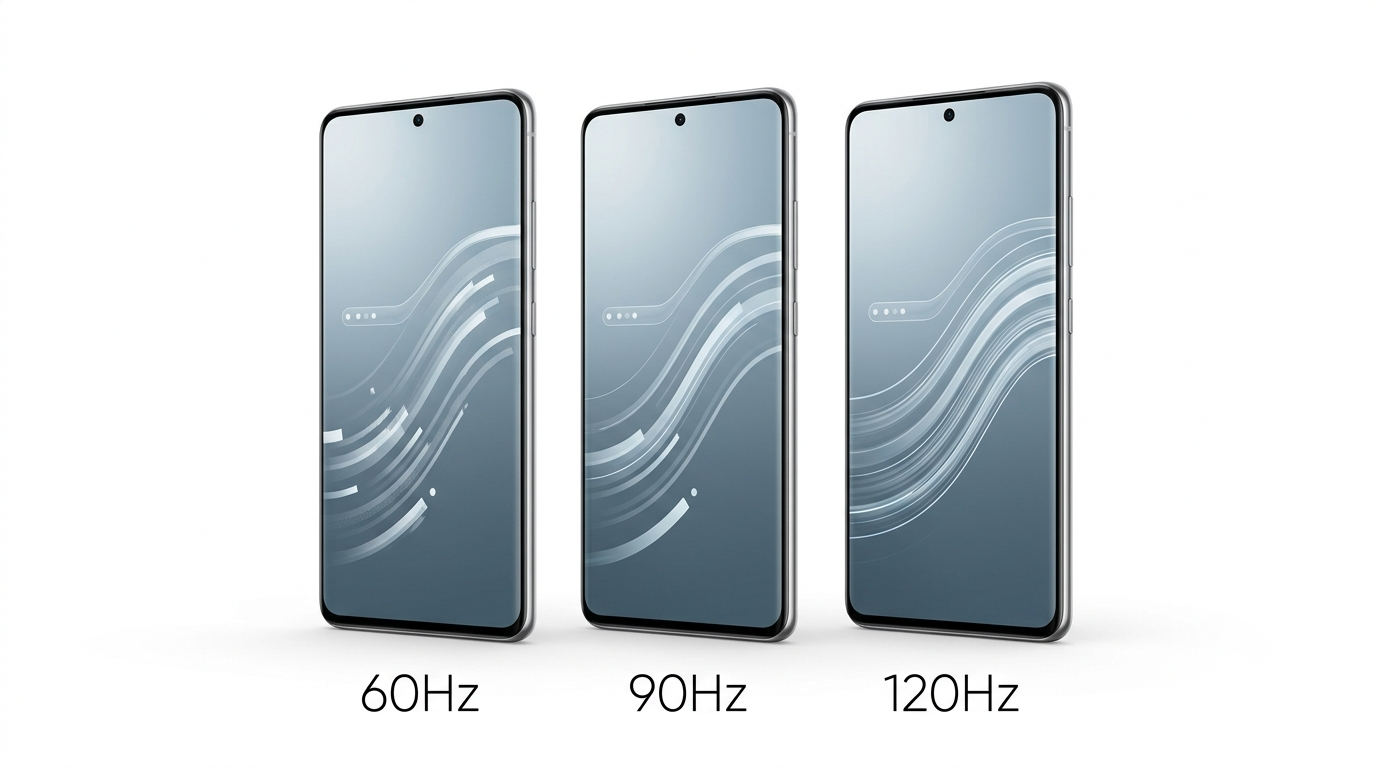
Nowadays, many phones offer refresh rates of 60Hz, 90Hz, or 120Hz.
Companies often present higher refresh rates as providing a better user experience.
however, the most expensive option is not necessarily the right choice for everyone.
To make the right selection, it is important to understand the differences between these options and assess your own specific needs.
What Is Refresh Rate?
Refresh rate refers to how many times a display can update the image on the screen in one second.
it is measured in Hertz (Hz). A 60 Hz screen can update 60 times per second, a 90 Hz screen 90 times, and a 120 Hz screen 120 times.
Generally, a higher refresh rate makes scrolling and the movement of objects on the screen appear smoother.
It is important to understand that refresh rate and frame rate are different things.
Simply having a 120Hz display does not automatically mean that a game will run at 120 frames per second.
for that to happen, support from the game, the processor, and the graphics hardware is also essential.
Benefits of 60Hz display
60 Hz is a refresh rate that has long been used in smartphones.
It is sufficient for everyday tasks such as calling, messaging, using social media, online learning, watching videos, and browsing the internet.
A high-quality 60 Hz screen can provide a clear and pleasant experience for daily use.
By opting for a 60 Hz display in budget phones, companies can allocate their budget toward other features.
this allows you to get a phone with a better camera, more storage, or a superior battery.
In some scenarios, running a screen at 60 Hz can also result in lower power consumption compared to using a higher refresh rate.
Limits of 60Hz
Scrolling or animations on a 60 Hz screen may appear less smooth compared to 90 Hz or 120 Hz displays.
if you have previously used screens with higher refresh rates, the difference might be more noticeable.
However, this does not mean that a 60 Hz phone is 'bad'—for typical users, it can still be a practical choice.
What is 90Hz display?
A 90Hz display can update the screen 90 times per second.
It serves as an intermediate option between 60Hz and 120Hz, making it a good choice for those who want a bit more smoothness while using their phone but do not wish to pay a premium for the highest refresh rates.
Benefits of 90hz display
A 90Hz refresh rate can be noticeable during daily use—such as when scrolling through social media feeds, opening menus, or switching between apps—especially when you scroll rapidly across the screen.
For budget and mid-range devices, 90Hz serves as a well-balanced option.
Some games support a 90Hz refresh rate (or lower), so you may experience a greater benefit in those supported titles.
however, not every game utilizes this refresh rate.
Additionally, the phone's processor and its operating temperature can also influence performance.
Limits of 90Hz
A phone with a 90 Hz or 120 Hz refresh rate does not automatically guarantee a superior experience.
the actual user experience is not defined solely by a number.
Factors such as screen brightness, color accuracy, responsiveness, and software optimization also play a crucial role.
Therefore, instead of buying a phone simply because it claims to have a 90 Hz display, you should always evaluate the overall quality of the display.
What is 120 hz display
A 90Hz display can update the screen 120 times per second.
this refresh rate is found in many mid-range and premium smartphones, and its purpose is to make scrolling, animations, and supported games appear smoother.
Benefits of 120Hz display
A 120 Hz screen can make scrolling and system animations appear much smoother.
Those who spend their day using social media, browsing web pages, or interacting with various apps on their phones may appreciate this experience.
the higher frame rate makes actions feel clearer and more responsive.
However, running a game at a high frame rate requires support from the processor, the GPU, and the game itself.
If a game is capped at 60 frames per second, it will remain limited to that frame rate, regardless of whether the screen supports 120 Hz.
It is also important to note that the 'touch sampling rate' is a distinct feature and should not be confused with the 'refresh rate.'
Limits of 120Hz
Certain refresh rates can consume more battery in some situations—especially when the screen is constantly running at 120Hz.
Many phones feature an "adaptive refresh rate," which adjusts the screen's refresh rate based on the task at hand, helping to conserve energy.
On some phones, you have to pay a premium to get a 120Hz display.
If your usage is limited to calling, messaging, and the occasional video, you might not notice a significant difference compared to 90Hz.
Therefore, be sure to consider your actual needs before spending extra money.
Which refresh rate is better for battery life?
Generally, a 60 Hz refresh rate may consume less power, but actual battery life is not determined solely by this.
factors such as screen brightness, the processor, mobile network usage, apps, and battery capacity also play a role.
Phones with an adaptive refresh rate can adjust the screen's refresh rate (Hz) based on requirements, striking a balance between smooth performance and battery conservation.
Which option should I choose for gaming?
For casual gaming, 60 Hz may be sufficient, while for fast-paced competitive games, 90 Hz or 120 Hz might be more appropriate—provided the games themselves support these refresh rates.
When purchasing a phone, also consider the GPU, the cooling system, and how much the device heats up during extended gaming sessions.
Simply having a 120 Hz display does not automatically guarantee better gaming performance.
What to look for when buying a smartphone
If your budget is limited and you only need to perform routine tasks, a phone with a decent 60 Hz screen can be a suitable choice.
If you are looking for a balance between price and a smooth user experience, consider a 90 Hz display.
alternatively, if you prefer very smooth scrolling, a 120 Hz phone might be a better option.
Before making a purchase, you should also seek information regarding screen brightness, color, resolution, battery, processor, and software updates.
If possible, try using the phone yourself, as the actual experience of the screen cannot be fully understood from specifications alone.
The screen refresh rate is not always constant.
Some phones allow you to choose between 60 Hz, 90 Hz, or 120 Hz, while others feature an "adaptive" mode that adjusts the rate automatically.
If you want to save battery, consider lowering the refresh rate.
if a smoother experience is your priority, choose the higher setting.
This feature may vary depending on the phone model, so be sure to check the specifications before making a purchase.
Assess your own needs, then select the option that best suits you.
conclusion
60 Hz, 90 Hz, and 120 Hz each have their own advantages.
60 Hz is sufficient for general use and limited budgets.
90 Hz offers a balance between a smoother experience and cost, while 120 Hz is useful for those who play supported games or prefer fast-paced motion on the screen.
Our advice: Don’t buy a phone just because it has a high refresh rate (Hz).
Consider your specific needs, budget, battery life, and other features as well.
The best smartphone is one that handles your daily tasks effectively and offers a reliable experience relative to its price.