Introduction
When buying a smartphone, we typically focus primarily on the RAM, processor, and camera.
however, a phone's internal storage also plays a significant role in its overall performance.
You may have noticed terms like "UFS 3.1" or "UFS 4.0" in the specifications of various smartphones.
These are storage technologies that influence how data is read from and saved to the device.
If you are thinking of buying a smartphone, it is important to know the difference between UFS 3.1 and UFS 4.0.
Are phones with UFS 4.0 faster? How important is this type of storage for gaming, and is it sufficient for everyday use?
What is UFS storage?
UFS stands for Universal Flash Storage.
It is a type of storage technology used in smartphones, tablets, and other technological devices.
On a phone, your photos, videos, apps, games, and other files are saved in the internal storage.
The UFS standard optimizes the process of reading files and writing new data to them.
For instance, when you install a large game or open a photo (such as a selfie) on your phone, the storage plays a crucial role.
Faster storage speeds allow tasks to be completed more quickly.
However, a phone's overall performance does not depend solely on the storage.
the quality of the processor, RAM, and software is equally important.
What is UFS 3.1?
UFS 3.1 is a mobile storage standard that was published by JEDEC in 2020.
This technology incorporates several features designed to facilitate faster data transfer and manage power consumption.
It is an older storage technology that can still be found in many smartphones today.
UFS 3.1 also includes a feature called "Write Booster," which helps increase data write speeds under certain conditions.
As a result, tasks such as installing apps, saving files, and writing large amounts of data become significantly faster.
Benefits of UFS 3.1
UFS 3.1 can deliver good performance for everything from general daily use to gaming and video recording.
If a phone is equipped with a capable processor and sufficient RAM, it also ensures a smooth experience when using apps, engaging with social media, or multitasking.
Another advantage is that UFS 3.1 is available in various phones, making it a practical option for those looking to purchase a smartphone within a limited budget.
Limits of UFS 3.1
Data transfer speeds in UFS 3.1 are lower compared to UFS 4.0.
The newer technology offers advantages for tasks such as installing large games, copying heavy files, and continuous data writing.
However, this does not mean that every phone with UFS 3.1 is slow.
a well optimize phone can still provide an excellent experience for day-to-day tasks.
What is UFS 4.0?
UFS 4.0 is a new storage technology compared to UFS 3.1.
it was published by JEDEC in August 2022. It focuses on data transfer capacity and energy efficiency, and it utilizes MIPI M-PHY 5.0 and UniPro 2.0 interface technologies.
Benefits of UFS 4.0
The most significant feature of UFS 4.0 is its high data transfer capacity, which proves advantageous when reading or writing large files—such as those for high-end games—or other substantial datasets.
This benefit is particularly noticeable in scenarios that frequently involve the handling of large volumes of data.
This technology is also designed for greater energy efficiency.
however, actual power consumption depends on the phone's hardware, the storage controller, and how the device is used.
Limits of UFS 4.0
Phones featuring UFS 4.0 are typically found in the premium or higher-end mid-range segments, which means some buyers might have to spend more to acquire one.
If your usage is limited to tasks like calling, messaging, using social media, and watching videos, the additional benefits of UFS 4.0 may not be very noticeable.
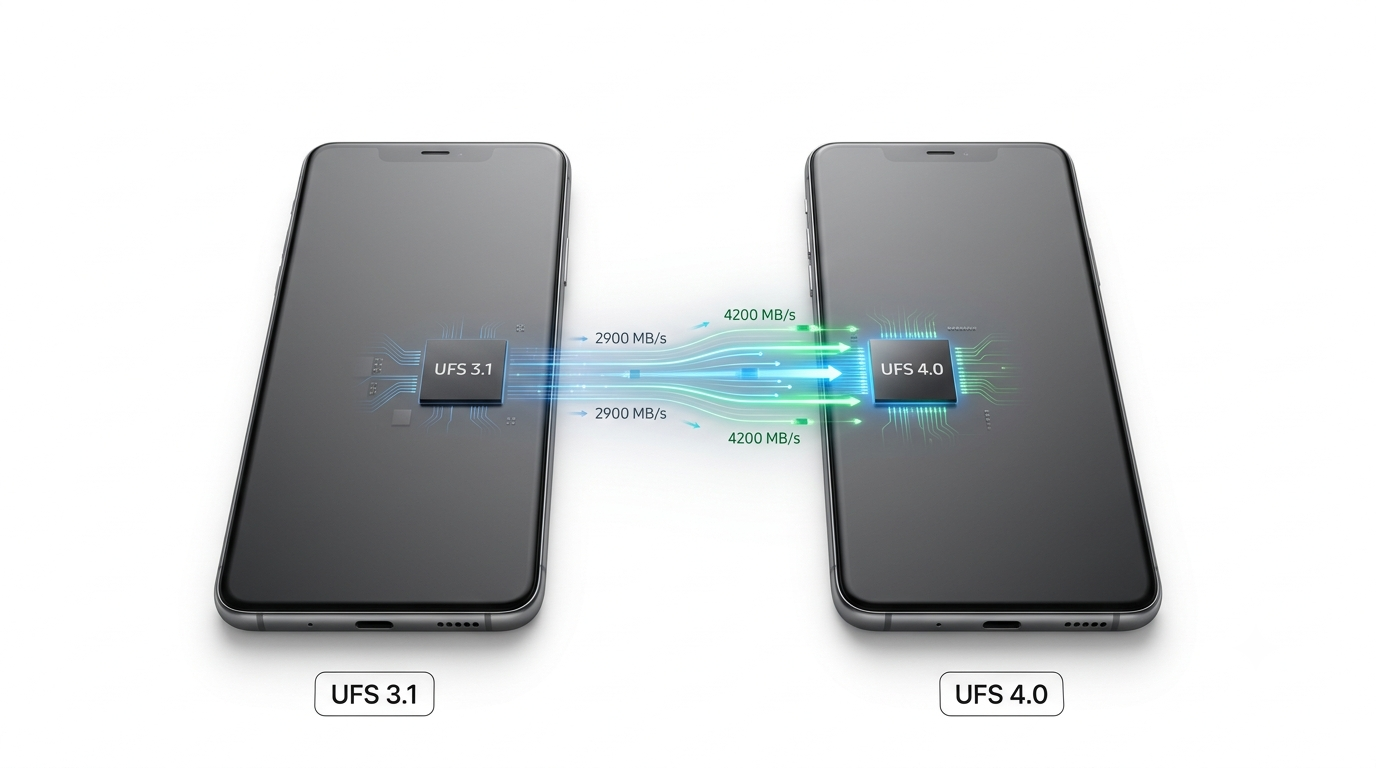
UFS 3.1 vs UFS 4.0: How much difference is there in speed?
According to data published by manufacturers, UFS 3.1 can deliver sequential read speeds of up to approximately 2,100 MB/s and write speeds of up to 1,200 MB/s.
For some UFS 4.0 products, read speeds of around 4,200 MB/s and write speeds of around 2,800 MB/s have been reported.
These are maximum theoretical figures, not the actual speeds experienced in every phone.
This difference does not mean that a smartphone equipped with UFS 4.0 will be twice as fast in every task.
factors such as the processor, RAM, network, and software also play a significant role in activities like web browsing and general messaging.
Which storage is better for gaming?
If you play games on your mobile, UFS 4.0 storage can be very useful.
It helps speed up tasks like installing games, reading large game files, and loading new gaming data.
However, storage alone is not enough for good gaming performance.
a capable processor and GPU are also essential.
A powerful smartphone equipped with UFS 3.1 storage can provide a great gaming experience.
What to choose for general use
If you use your phone for social media, video streaming, online learning, calling, and general apps, then UFS 3.1 storage may be sufficient.
in such usage scenarios, the difference offered by UFS 4.0 might not always be noticeable.
However, if you download large games, transfer heavy files, or frequently perform video editing on your phone, then UFS 4.0 could be a better choice.
Things to keep in mind when buying a smartphone
Do not buy a phone based solely on its UFS version.
first, consider the processor, RAM, battery, camera, and internal storage capacity.
For some users—especially those who store a large number of photos and videos—a phone with 256GB of UFS 3.1 storage might be more practical than one with 128GB of UFS 4.0 storage.
Also, keep in mind that two phones with the same UFS version may not necessarily offer the same actual speed.
Factors such as storage capacity, the controller, software, and the manufacturer's optimization all influence performance.
Conclusion: Which is better, UFS 3.1 and UFS 4.0?
UFS 3.1 and UFS 4.0 are both types of storage technologies.
UFS 3.1 is sufficient for general use and for those purchasing a budget-friendly smartphone.
On the other hand, UFS 4.0 offers superior data transfer capabilities, making it a better choice for users who perform demanding tasks.
Our advice: If there isn't a significant price difference between the two phones and the other features are similar, choosing the model with UFS 4.0 storage could be advantageous.
However, if a phone with UFS 3.1 offers a better processor, more storage, or a superior battery, that would also be a sensible choice.
Ultimately, the best phone is the one that delivers the right performance according to your budget and needs.