Introduction
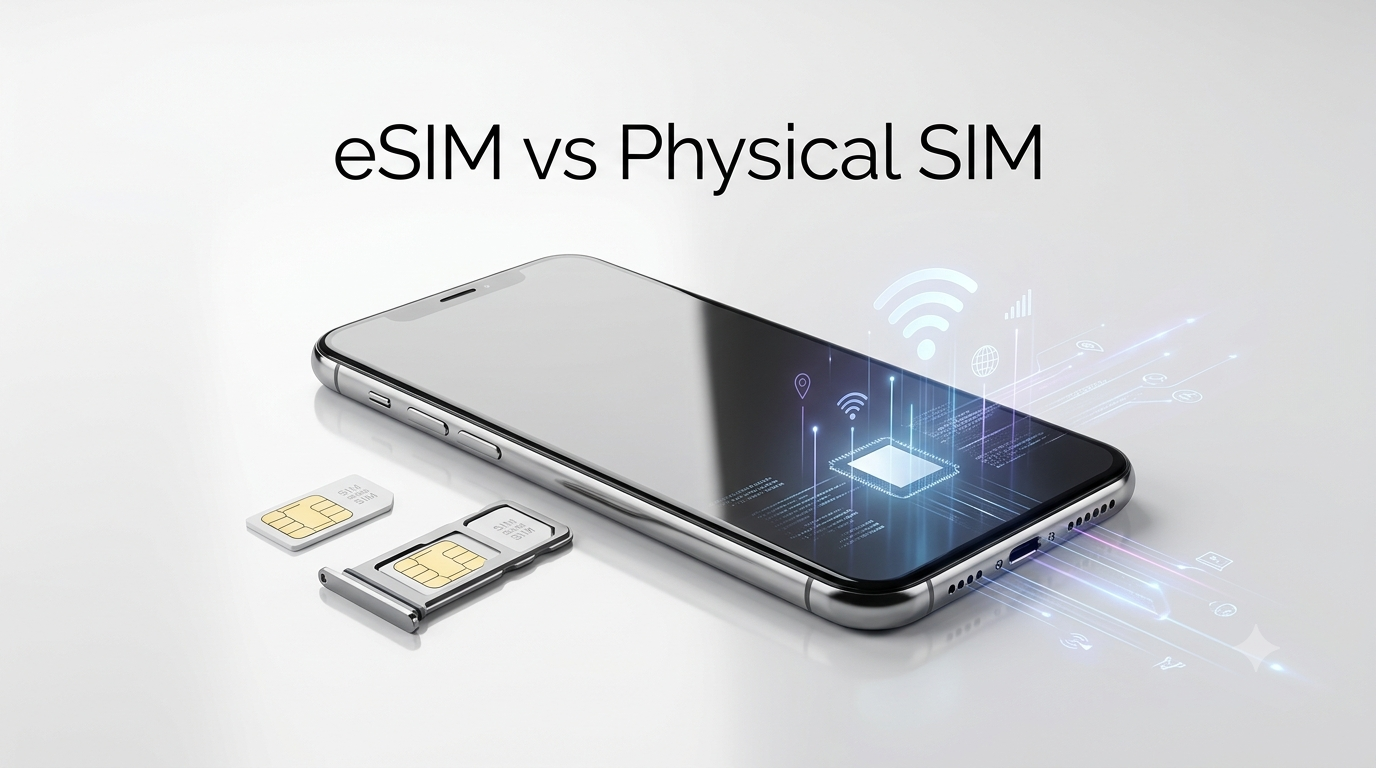
Nowadays, smartphones offer the option of an eSIM alongside a physical SIM.
Both serve the same purpose—connecting to a mobile network, making calls, sending messages, and accessing the internet—yet they function differently.
If you are buying a new phone, it is useful to understand the differences between an eSIM and a physical SIM, and which option might be better for you.
What Is a Physical SIM?
A physical SIM is a small card that is inserted into a phone's SIM tray.
it contains identification information linked to a mobile network.
Most phones today use physical SIMs.
A major advantage is that the SIM can be removed from one phone and inserted into another—for instance, if your phone breaks, you can simply move the SIM to a different device to continue using your number.
However, physical SIMs can be lost or damaged.
Furthermore, the phone must have a dedicated SIM slot to accommodate one.
If the SIM tray breaks or the card fails to function correctly, it can lead to connectivity issues.
What Is a eSIM?
The full form of eSIM is "embedded SIM."
It is a small chip built into the phone, so there is no need to physically insert or remove it.
Depending on the mobile operator, the eSIM can be activated via a QR code or another similar process.
Once activated, it can be used for calls, text messages, and mobile data.
However, not all phones or mobile operators support eSIM.
therefore, it is essential to check the phone's specifications and your operator's offerings before purchasing a device.
The main difference between the two
A physical SIM is a separate card, whereas an eSIM functions as a digital profile already present within the phone.
Transferring a physical SIM to a compatible phone is generally straightforward.
however, moving an eSIM to another device may require a specific process from the operator, such as a profile transfer or re-activation.
With an eSIM, there is no risk of needing to physically insert or remove a card.
On the other hand, physical SIMs have been in use for a long time and are widely available for various phones.
It is important to note that call quality and internet speed are not determined solely by the type of SIM.
rather, they depend on factors such as network coverage, the operator, the phone's antenna, and the network technology being used.
Benefits of eSIM
The biggest advantage of an eSIM is convenience.
the connection can be activated digitally on the phone, eliminating the need for a physical card.
It is particularly useful when traveling abroad, as users can purchase data plans for specific countries, allowing them to utilize local networks.
Some phones support both a physical SIM and an eSIM, enabling users to keep their personal and work numbers separate, or to use both connections for different requirements.
However, the availability of this feature depends on the specific phone model and the network operator.
Unlike a physical SIM, an eSIM cannot be removed from one device and inserted into another.
While this reduces the risks associated with physically removing a SIM card, it does not entirely eliminate the possibility of fraud related to the phone or the user's account.
Disadvantages of eSIM
The biggest drawback of this type of SIM is that it is not available on every phone.
Many older devices and some budget smartphones only support physical SIM cards.
therefore, it is essential to check the manufacturer's official specifications before making a purchase.
Transferring this SIM when switching phones can be more complex than simply moving a physical SIM card.
It may require following specific procedures set by the operator, and in some cases, an internet connection is necessary.
Furthermore, if a phone suddenly breaks down, it may take some time to get the number activated on a different device.
Pros and cons of a physical SIM
The advantage of a physical SIM lies in its simplicity.
you can remove the card and insert it into another compatible phone, usually without needing to set up a new digital profile.
This is particularly convenient for those who frequently switch phones or own multiple devices.
On the downside, the card can break, get damaged, or be lost. When changing SIMs, one must ensure the old card is kept safe.
Furthermore, the phone must have a physical SIM slot; some devices may have a limited number of slots or restricted support for certain networks.
Who is better in terms of security?
It is not possible to simply remove a SIM card from one phone and insert it into another device without notice.
in this regard, there is an advantage. However, this does not guarantee complete security for the SIM.
Unauthorized access to an account, identity theft, or fraud related to the mobile operator can still occur.
A SIM card can be removed from one phone and placed into another compatible device.
In either scenario, it is essential to use a screen lock, keep your mobile account secure, and never share your OTP with anyone.
If your phone is lost, contact your mobile operator immediately to secure your number and connection.
Who should choose which SIM?
If you want to easily remove your SIM card and insert it into another phone, a physical SIM is a practical option.
it is also suitable for those whose phones do not support eSIMs.
If your phone and mobile operator support it, an eSIM can be quite convenient.
It is particularly useful for those who travel abroad or for users who wish to keep both a personal and a work number on a single device.
However, you should first check how many numbers can remain active simultaneously on your phone, and also verify the process your operator provides for transferring the eSIM.
conclusion
Both eSIMs and physical SIMs are good options for accessing mobile networks.
An eSIM allows for digital activation, eliminating the need for a physical card, whereas a physical SIM can often be easily transferred between compatible phones.
If your phone and mobile operator support eSIMs, you might choose one for the sake of convenience.
however, if you prefer a simpler way to swap cards, a physical SIM might be a better choice.
The right option is the one that best suits your phone, your mobile network, and your daily needs.